UAE Leaders Join Iftar at BAPS Temple, Reflecting Change
Emirates model unity through tolerance, harmony, and progress—modernising without losing identity


UAE’s Inclusive Growth Model Offers Lessons for India and Islamic Nations
Over the years, India and the United Arab Emirates’ relationship has developed into a vibrant and strategic alliance, moving beyond centuries-old trading contacts. Because of these historical ties, the Indian rupee was originally widely used throughout the Trucial States, which eventually merged to form the United Arab Emirates.
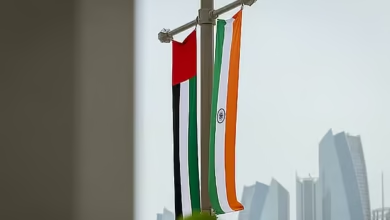
This bond has gained renewed prominence in recent years. When Indian Prime Minister Narendra Modi visited the UAE for the first time in 2015, it was a landmark event. It sparked a series of high-level visits and partnerships, marking a sea change in bilateral diplomacy. Another sign of the growing friendship and trust between the two countries was the recent visit to New Delhi by Dubai Crown Prince Sheikh Hamdan bin Mohammed Al Maktoum. As the UAE looks increasingly east for cooperation and progress, India has emerged as a key ally under Modi’s leadership.
A pivotal transformation
It is truly amazing how the UAE has evolved from a conglomerate of small desert towns to a contemporary, internationally acclaimed nation. Its success stems from its enduring commitment to tolerance, creativity and cultural harmony, as evident in its skyscrapers and oil wealth. Few countries have succeeded in creating a development model that strikes a balance between traditional values and progressive governance.
At its core is this model’s commitment to religious and cultural inclusion. The many places of worship, including churches, temples, gurdwaras, and synagogues, stand in harmony with mosques, demonstrating the harmonious coexistence of the more than 200 ethnic groups that make up the UAE.
Initiatives such as the BAPS Hindu Temple in Abu Dhabi and the Abrahamic Family House, which combines a synagogue, a church and a mosque into one structure, are powerful representations of the UAE’s worldview. These initiatives reflect a deliberate effort to foster tolerance and mutual understanding across religious boundaries; they are not just about infrastructure.
Competency- and values-based education
The UAE’s education system is a fundamental component of its inclusive approach. While Muslim students have access to Islamic studies, the emphasis is on the Arabic language curriculum for all students, regardless of background. This ensures that each student develops an awareness of the beliefs of others and establishes a shared cultural thread. Despite the common belief that religious education and modern progress hinder the latter, the UAE has demonstrated how it can work together.
This approach produces not only academically talented individuals, but also culturally sensitive and religiously grounded citizens who can meaningfully engage in a diverse world.
Symbolic gestures, intimate meaning
The actions of the UAE leadership demonstrate its commitment to interfaith cooperation beyond policy. This is a recent example of this, when Sheikh Nahyan bin Mubarak Al Nahyan, Minister of Tolerance and Coexistence, attended an iftar gathering at the Hindu BAPS temple. These events show how spirituality and mutual respect can coexist under a common national identity, and reflect a deep respect for all religions.
A model for India and the Muslim world
The UAE is proof that religious identity and contemporary goals can coexist peacefully, although other regions find it difficult to do so. It views diversity as a strength rather than a problem, using it to promote economic innovation, global goodwill, and social cohesiveness.
As India debates the future of religious education, especially around the modernisation of the madrasa system, there is much to learn from the UAE’s thoughtful path. The emphasis should be on adopting models that combine faith and foresight, tradition with technology, rather than being afraid of change.
In contrast to these positive discussions, the role of religion in public life continues to be a contentious issue in many Islamic countries, including elements of Indian culture. The UAE is actively participating in global discussions on the role of artificial intelligence, ethics, and religious concepts in the digital era.
Progress in identity
The UAE’s journey is a powerful example of how inclusive policies, cultural appreciation, and innovative leadership can elevate a country’s reputation internationally. It shows that modernization should not replace tradition, and provides a model for diverse democracies like Islamic countries and India.
Nations can move toward a brighter future by choosing role models that value progress based on cultural trust and unity in diversity. In many ways, the UAE serves as India’s partner and a window into what can be achieved when prosperity and inclusion coexist.