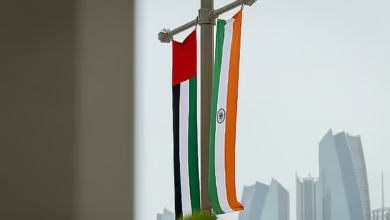
UAE invests heavily in Africa for resources and influence
As US and China Scale Back, UAE Invests Billions in African Ports, Minerals, and Renewable Energy to Diversify Economy


UAE Expands Economic and Strategic Influence Across Africa Amid Shifting Global Investments
The United Arab Emirates (UAE) is well-represented in Africa’s major economic and strategic centers, from important ports on important trade routes to mineral-rich mining areas and massive renewable energy projects. As traditional global powers like the United States and, to a lesser degree, China reduce their investments, aid, and on-ground involvement across the continent, the UAE is rapidly stepping in to fill the gap by leveraging its substantial financial resources.
The Persian Gulf has seen a sharp increase in investment in recent years, especially from the Emirates. Since 2019, agreements considerably beyond the pledges of any other country have been made, with deals totaling over $110 billion, mostly facilitated by businesses with close ties to the UAE’s ruling class. According to Anna Jacobs, a nonresident fellow at the Arab Gulf States Institute in Washington, “The UAE is emerging as a dominant foreign player in Africa’s economic landscape.”
This momentum is expected to grow further with political support from the United States. During former President Donald Trump’s administration, efforts to attract Emirati investment to the United States increased, resulting in the approval of the sale of cutting-edge American artificial intelligence chips to the UAE. These moves support the Emirates’ ambitions to lead the world in innovation, technology and finance.
Like many Gulf oil-exporting countries, the UAE is actively working to diversify its economy away from fossil fuels. With its excellent agricultural potential, rapidly growing population, abundant mineral resources and strategically advantageous location along important waterways such as the Atlantic, Mediterranean, Indian and Red Seas, Africa is essential to achieving this goal.
Prominent Emirati companies, headquartered in Dubai and Abu Dhabi, frequently engage with the government and have operations in Africa. For example, AMEA Power oversees or develops renewable energy projects in Burkina Faso, Djibouti, Egypt, Ethiopia, Ivory Coast, Kenya, Morocco, South Africa, Togo, Tunisia and Uganda, and it plans to grow further. Abu Dhabi National Energy operates in South Africa, Morocco, and Senegal in a similar manner.
From Algeria to Zambia, the enormous government-backed port and logistics company DP World has made billions of dollars in investments in economic free zones and port infrastructure. The UAE has also set up a military facility in the breakaway Somaliland area, where Berbera port is where it operates.
The mining industry continues to see significant investments; this year, Emirati International Holding paid more than $1 billion to acquire a majority 51% stake in Zambia’s Mopani Copper Mines. Another key area of concentration is Egypt, where the UAE committed to spending $35 billion to build a new metropolis and tourism attraction along the Mediterranean coast.
While China remains a major player on the continent—historically the largest investor through its Belt and Road Initiative—it has scaled back its African commitments in recent years, partly due to a series of debt crises both on the continent and domestically. In contrast, the UAE announced investments totaling $97 billion in Africa during 2022 and 2023 alone, which is approximately three times more than China’s investments in the same period, according to fDi Markets, a foreign direct investment tracking database. Meanwhile, US investments hovered around $10 billion in 2023.
Concurrently, the United States has accelerated its disengagement from Africa under the Trump administration by cutting billions in aid, dismantling the USAID office, and halting contributions to the African Development Bank, signaling a shift away from direct involvement on the continent.