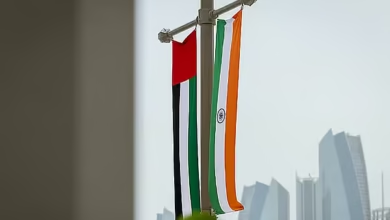
UAE attends Global Alliance meeting in Riyadh for two-state solution
UAE Reaffirms Commitment to Peace, Civilian Protection, and Regional Stability at High-Level Global Alliance Conference


UAE Participates in Global Alliance Meeting in Riyadh to Advocate for Two-State Solution
The United Arab Emirates (UAE) recently attended a high-level Global Alliance meeting in Riyadh to support the two-state solution for the Israeli-Palestinian conflict. Hosted by Saudi Arabia, this significant conference took place from October 30-31 and saw the participation of 94 countries and international organizations. Keynote speeches were delivered by Saudi Foreign Minister Prince Faisal bin Farhan Al Saud and Philippe Lazzarini, Commissioner-General of the United Nations Relief and Work Agency for Palestinian Refugees (UNRWA), underscoring the international commitment to peace and stability in the region.
UAE’s Role and Advocacy for Peace
Representing the UAE, Lana Nusseibeh, Assistant Minister for Political Affairs at the Ministry of Foreign Affairs, praised Saudi Arabia’s influential role in fostering international cooperation on the two-state solution. She highlighted the UAE’s dedication to achieving a peaceful coexistence between an independent Palestinian state and Israel, emphasizing that both states must live in harmony with each other and neighboring countries. Nusseibeh rejected actions that undermine this goal, urging an end to policies that solidify divisions on the ground.
Demand Humanitarian Aid and Civilian Protection in Gaza
Nusseibeh reaffirmed the UAE’s demand for the security of civilians and relief workers in conflict areas amid the rising violence. She urged for unfettered access to vital supplies and emphasized the UAE’s pivotal role in providing humanitarian relief to Gaza. She emphasized the catastrophic humanitarian situation, especially in northern Gaza, where recent food security assessments have shown that over 1.8 million people are suffering from acute food insecurity, and 400,000 people risk severe relief shortages. Nusseibeh denounced acts that hindered UNRWA’s operations, emphasizing the organization’s vital role in aiding Palestinian refugees and the requirement that its personnel and infrastructure be protected in accordance with international humanitarian law.
Regional Concerns and Stability
In her address, Nusseibeh cautioned against escalating violence across the Middle East and reiterated the UAE’s demand for an immediate, unconditional ceasefire in Gaza, along with the release of all hostages and detainees.She voiced deep concern over the impact of conflict on regional stability, particularly in Lebanon, where rising tensions threaten national unity and sovereignty. The UAE reaffirmed its support for Lebanon’s territorial integrity and the welfare of its citizens during these turbulent times.
Combating Hate Speech and Settler Violence
At the conference, the UAE drew attention to the dangers of hate speech and rising settler violence in the West Bank, where attacks on Palestinians have continued without accountability. Nusseibeh referenced United Nations Security Council Resolution 2686 (2023), which addresses the harmful effects of hate speech, extremism, and intolerance as conflict drivers, and encourages states to counteract these forces collaboratively.
She highlighted the devastating toll that incitement and violence have on regional peace, stressing the UAE’s commitment to fostering tolerance and peace.
Dedication to Humanitarian Aid and Regional Stability
The UAE demonstrated its commitment to a fair and sustainable settlement to the Israeli-Palestinian conflict by attending the Global Alliance summit in Riyadh. Nusseibeh’s visit demonstrated the UAE’s all-encompassing strategy, which includes supporting humanitarian access, safeguarding civilians, urging regional stability, and denouncing hate crimes. By these initiatives, the UAE highlighted how crucial international collaboration and diplomatic solutions are to bringing about long-term peace and stability in the Middle East.