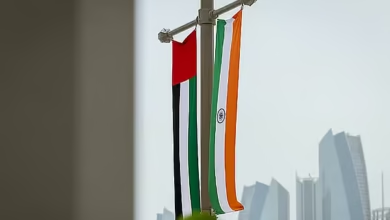
Focus: Gaza war cools Israel’s business ties with UAE
Gaza Conflict Impacts Israel-UAE Business Ties Amid Diplomatic Tensions

Summary:
After the 2020 agreement, bilateral trade has grown with a flurry of deals
Gaza suspends war declarations as UAE officials insist on discretion
Sources say the war has damaged the UAE’s relations with Netanyahu
JERUSALEM/DUBAI, May 8 – The Gaza war has chilled Israeli business activity with the United Arab Emirates, a once-celebrated relationship held out of public scrutiny amid anger in the Arab world over the conflict.
In 2020, the UAE became the most important Arab country in 30 years to establish formal relations with Israel under a US-brokered deal known as the Abraham Accords. It has maintained ties throughout Israel’s more than six-month war in Gaza.
Following the agreements, Israeli entrepreneurs began arriving in the Gulf nation on direct flights from Tel Aviv, establishing new business relationships and expanding ties that had once been kept secret. The deals announced before the war include investments in cyber security, fintech, energy and agricultural technology.
Ten Israeli officials, executives and entrepreneurs told Reuters that business ties with the influential Gulf state remained intact, but they declined to discuss any recent deals, in a sign that the conflict has stoked tensions.
Said Raphael Nagel, a German-Jewish businessman living in the United Arab Emirates who heads a private business group that promotes business ties between Israel and the Gulf Arab states.
Six bankers and lawyers in the United Arab Emirates said business ties between Israeli and Emirati companies are enduring the war but few new deals are underway. They said the UAE government is cautious about improving relations with Israel. In Israel, meanwhile, many businesses have employees called up for military service, which has affected operations.
A UAE official did not directly respond to questions from Reuters about how economic relations with Israel have been affected by the war. However, the UAE’s diplomatic and political dialogue with Israel has helped humanitarian efforts to help the people of Gaza, the official said.
The UAE is the only Arab country that still hosts an Israeli ambassador. Tel Aviv has withdrawn ambassadors from other Arab countries it has ties to following the October 7 attack by Hamas that prompted its invasion of Gaza.
Israel’s foreign ministry did not respond to a request for comment. After establishing formal diplomatic ties in 2020, Israel and the United Arab Emirates quickly forged a close economic partnership, while decades of peace accords with Egypt and Jordan failed to establish significant trade ties. A trade deal was signed in 2022.
Last year, trade grew 17% to $2.95 billion, according to data from Israel’s Central Bureau of Statistics. The bureau said trade was up 7% year-on-year in the first quarter of 2024, despite a cooling backdrop to the war.
But Israeli tourists, who often visit the UAE, no longer fill Dubai’s hotels, restaurants and bars – even though Israelis and Jews say they continue to feel safe in the country.
Unlike other Arab countries, there have been no public demonstrations in support of the Palestinians or against Israel in the UAE. However, symbols associated with Palestinian nationalism, such as the black and white keffiyeh headscarf, can be seen worn by people on the streets of Dubai.
“Things have become very sensible and there’s a lot to be done by October 7,” said Bruce Kurfein, an American Jew and businessman who first moved to the UAE in the late 1990s. Hamas militants killed 1,000 Israelis and took more than 250 hostages. In response, Israel launched an invasion of the Gaza Strip – with the aim of destroying Hamas and freeing the hostages. – According to Palestinian officials, more than 34,000 people were killed. International efforts to mediate a ceasefire are underway.
The ‘chilling’ effect:
Many Israelis who were already doing business in the UAE before the war said their personal and business relationships with Emiratis and other Arabs in the UAE were not affected. But they also say there is a demand on both sides that business relationships not be made public.
“I think cooling is a fair word,” said Eli Wurtman, co-founder of Israeli venture capital firm PICO Venture Partners. “But, on the other hand, … it’s business as usual.”
Wurtman believes that the close ties that developed in the immediate period after normalization helped sustain business ties with the UAE, a sentiment echoed by Israeli officials and other executives Reuters spoke to.
An Israeli executive at the UAE-IL Zone, a non-governmental Israeli platform aimed at promoting UAE-Israel business links, said Emirati officials had promised that investment in Israel would not stop during the war but asked the Israelis. Avoid publishing announcements about contracts.
The executive asked not to be identified because they are not authorized to speak to the media. A UAE official declined to comment. Michael Mirilashvili, CEO of Watergen, an Israeli company that develops machines to produce drinking water from air, signed a three-way water research collaboration agreement in June 2021 with Abu Dhabi company Bainuna and Tel Aviv University to advance research in water technology. .
Mirilashvili said that the partnership with his Emirati counterparts is warm and that he has not noticed a difference in relations since October 7.
We continue to work together, he said. “We have a very strong bond with the people who work there.”
Tel Aviv University and Bainuna did not respond to a request for comment.
Robert Mokielnicki, a scholar at the Arab Gulf Institute in Washington, said the war in Gaza was a “great incentive” for the UAE to undertake major new economic initiatives. He noted growing anger and anxiety about the war among UAE citizens, a minority of about 1 million in the Gulf state’s population of 10 million.
Abu Dhabi state oil company Adnoc and BP have put on hold plans to take a $2 billion stake in Israeli gas producer NewMed, the Israeli company said in March, citing regional uncertainty. Four sources familiar with Adnoc’s position said the war in Gaza had influenced the decision to suspend negotiations, citing the optics of moving forward with such a large deal. Didier Toubia, chief executive of alternative meat startup Alef Farms, which received investment from the Abu Dhabi state fund in a 2021 funding round, told Reuters there was now heightened sensitivity around Israeli companies doing business with Emirati companies. He predicted an acceleration in business activity once the war ended.
Frustration with Netanyahu
UAE officials have said building ties with Israel was a strategic decision and they do not intend to reverse it. Some of them, however, expressed personal frustration with Israel, the war on it and the high civilian death toll.
Israel has strongly denied any deliberate targeting of civilians.
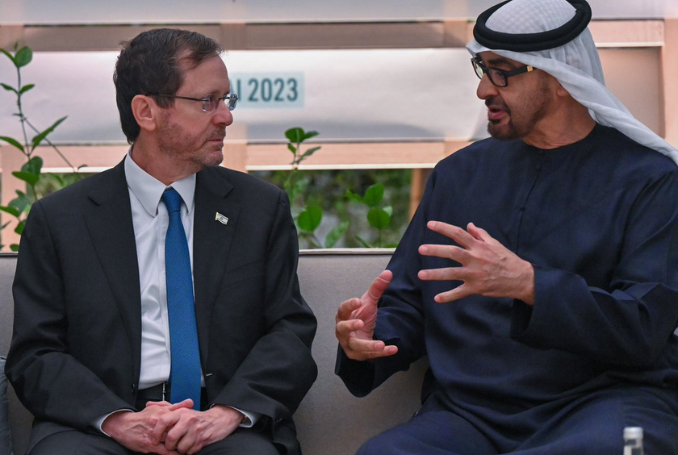
The war has strained the UAE’s relationship with Israeli Prime Minister Benjamin Netanyahu, according to four sources familiar with the matter. They said the UAE now rarely talks directly with Netanyahu, and President Isaac Herzog has been a key figure in Israel-UAE relations.
As Emiratis’ frustration with Netanyahu grew, the UAE has increasingly engaged former prime ministers Yair Labit and Nafatali Bennett since Oct. 7, the sources said.
Netanyahu’s office declined to comment. Herzog’s office, as well as spokesmen for Lapid and Bennett, declined to comment.
The UAE official did not directly respond to questions about the relationship with Netanyahu’s government, but called for serious efforts to reach “a comprehensive and just peace” based on a two-state solution.
Israeli opposition leader Lapid met with Foreign Minister Sheikh Abdullah bin Zayed Al Nahyan in Abu Dhabi on May 2.