Oman and UAE floods “probably” connected to climate change, say scientists
New Study Highlights Fossil Fuel Emissions as Probable Cause of Catastrophic Rainfall

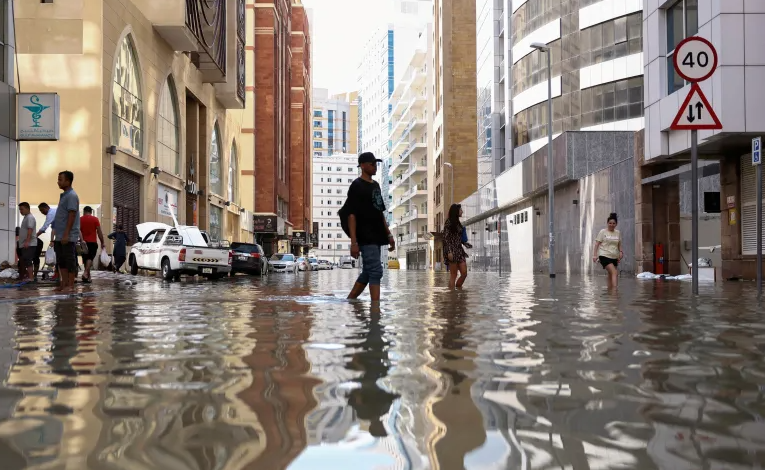
Climate Change Implicated in Deadly UAE and Oman Floods
A recent study conducted by the World Weather Attribution (WWA), a coalition of 21 international researchers, has shed light on the devastating floods that ravaged Oman and the United Arab Emirates (UAE) last week. According to the findings, the unprecedented rainfall, which resulted in the loss of 21 lives in Oman and four in the UAE, is “most likely” linked to global warming fueled by the emissions from fossil fuels.
The study, published on Thursday, underscores the significant role of climate change in exacerbating extreme weather events, though it acknowledges the challenge of definitively attributing such events solely to human-induced climate change. Nevertheless, the researchers assert a compelling correlation between the intensity of rainfall and the warming of the planet due to human activities, particularly the burning of fossil fuels.
Notably, the research highlights the impact of El Nino years, during which extreme rainfall in the affected regions has become notably heavier, increasing by 10-40 percent. This escalation in precipitation is primarily attributed to the warming atmosphere, a consequence of fossil fuel emissions. The study emphasizes that no other known factors can adequately explain the drastic rise in rainfall observed in recent years.

The devastating floods serve as a stark reminder of the escalating risks associated with extreme weather events in regions traditionally characterized by aridity or experiencing heightened temperatures due to global warming. Even in dry regions like Oman and the UAE, the vulnerability to precipitation-related hazards is on the rise, as emphasized by Sonia Seneviratne, a WWA member and professor at Zurich’s ETH university.
By analyzing historical weather data and climate models, the study reveals a clear trend: extreme rainfall events have become at least 10 percent heavier in the UAE and Oman with a warming of 1.2 degrees Celsius (2.2F) above pre-industrial levels. This finding underscores the fundamental principle that a warmer atmosphere can retain more moisture, leading to more intense rainfall, as elucidated by Mariam Zachariah, another WWA member and researcher at London’s Imperial College.
The impact of the recent storm, which struck Oman on April 14 before hitting the UAE on April 16, was unprecedented, causing flash floods and extensive damage to infrastructure. Dubai, in particular, faced severe disruptions, with major roads submerged, power outages, and significant flight cancellations at Dubai Airport. Despite the severity of the situation, UAE Prime Minister Sheikh Mohammed bin Rashid Al Maktoum announced a substantial package for home repairs.
Friederike Otto, a climatologist and WWA member, underscores the urgent need for global action to transition away from fossil fuels. Despite international agreements, such as those made at COP28 in Dubai, where nations pledged to reduce reliance on fossil fuels, the continued opening of new oil and gas fields poses a significant challenge. Otto warns that failure to curb fossil fuel consumption will inevitably lead to increasingly intense rainfall in many parts of the world, resulting in more devastating floods and exacerbating the impacts of climate change.