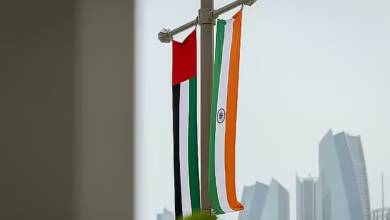
Li calls for a high-quality BRI partnership with the UAE
Li Qiang calls for stronger trade and infrastructure ties during UAE visit


Premier Li Qiang Highlights UAE’s Key Role in China’s Middle East Diplomacy, Calls for Strengthened BRI Cooperation
Premier Li Qiang has concluded his official visit to the United Arab Emirates, where he highlighted the Gulf country’s role in China’s Middle East diplomacy and called for opening up new opportunities for bilateral cooperation.
Li returned to Beijing on Friday after a four-day regional tour that also brought him to Saudi Arabia.
Addressing the UAE-China Business Forum held in Dubai on Thursday, the relations between the two countries stand at a historic juncture, while economic and trade cooperation faces significant opportunities for improvement.
More than 200 representatives from governments, chambers of commerce and trade organizations from both countries participated in the forum.
The Prime Minister called on companies from both countries to take advantage of new opportunities for high-quality Belt and Road cooperation and enhance cooperation in areas such as connectivity, infrastructure and financing to promote deeper integration in global industrial and supply chains.
Li further urged companies to identify shared interests and opportunities for cooperation from the intersection of their strategic priorities, and deepen cooperation in trade, new energy, tourism and other fields.
Cooperation in advanced sectors like advanced manufacturing, digital economy and artificial intelligence should also be emphasized to jointly exploit future development opportunities, he said.
China welcomes more companies from the UAE to invest in the country, Li said, adding that he believes that with the joint efforts of entrepreneurs from both sides, bilateral trade cooperation will continue to flourish.
UAE investment in China is set to grow by 120 percent by 2023, representing 90 percent of all Arab investment in China, said Chinese Ambassador to the UAE Zhang Yiming.
China’s investment in the country is growing at more than 16 percent annually, reaching $1.3 billion in 2023 and accounting for 60 percent of China’s total investment in Arab countries.
In the Middle East, the UAE is China’s second largest trading partner, largest export market and third largest market for Chinese engineering projects.
On Thursday, Li also held talks with UAE Vice President and Prime Minister Sheikh Mohammed bin Rashid Al Maktoum.
This year marks the 40th anniversary of the establishment of diplomatic relations between China and the United Arab Emirates.
Over the past four decades, the two countries have signed more than 130 bilateral agreements and MoUs. And in 2018, the two countries upgraded their relations to a comprehensive strategic partnership.
China has long prioritized the UAE in its Middle East diplomacy, and is willing to work with the country to firmly support each other and strengthen the political foundation of bilateral relations, Li said.
He stressed that China and the UAE are good partners on the path of common development, and it is in the fundamental interests of both sides to strengthen bilateral cooperation and help each other succeed.
A reciprocal visa waiver arrangement between the two countries came into effect on January 16, 2018, making the UAE the first country in the Middle East to have full visa waiver status with China.