Dubai Introducing 100+ Flying Cars for Faster Door-to-Door Travel
Training for a couple of months will precede individuals' ability to drive and fly the vehicle

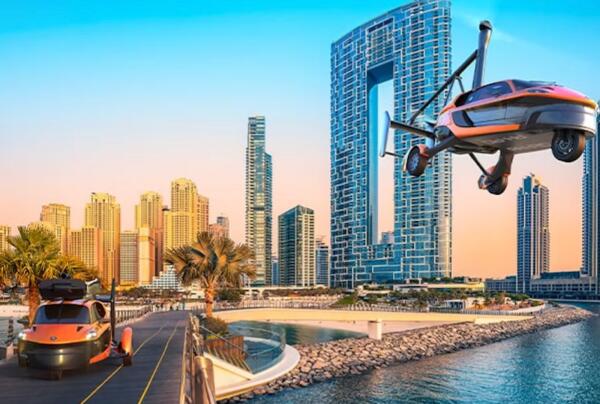
Aviterra Orders 100+ Flying Cars to Revolutionize Urban Mobility in Dubai
Aviterra, a pioneering Dubai-based company, has made a significant stride in the realm of futuristic transportation by placing a monumental order for over 100 flying cars, set to revolutionize urban mobility upon their anticipated launch in 2025-26. The acquisition of two-seater PAL-V’s Liberty flying cars, under the auspices of private jet charter Jetex, underscores Aviterra’s commitment to offering innovative last-mile solutions to residents across the region.
Dubai-based Company Sets Sights on Futuristic Transportation Solutions
Mouhanad Wadaa, the esteemed managing director of Aviterra, provided insightful details on the remarkable capabilities of the PAL-V Liberty. This groundbreaking vehicle seamlessly transitions from a fully functional car to a flying vehicle within a remarkably brief 2-minute timeframe. Operating on a standard automotive fuel, it requires only a modest 120-meter strip for takeoff and can ascend to impressive altitudes of up to 11,000 feet. Upon landing, users can seamlessly transition back to ground transportation, driving the vehicle to their desired destination with the ease and familiarity of a conventional car.
Distinguished as the world’s first real flying car, the PAL-V Liberty represents a quantum leap in transportation dynamics, amalgamating the functionalities of a gyroplane and an automobile to transcend the conventional limitations associated with urban commuting. With an impressive flight range of 500 kilometers and a maximum airspeed of 180 kilometers per hour, the Liberty is poised to significantly reduce commute times and enhance travel flexibility for urban dwellers, heralding a new era of urban mobility.
In a strategic maneuver aimed at solidifying its position in the emerging market of urban air mobility, Loggia Investment, the esteemed investment arm of Aviterra, has made strategic investments in PAL-V and forged strategic partnerships catering to the Middle East and Africa region. This concerted effort underscores Aviterra’s commitment to fostering innovation and driving transformative change in the realm of urban transportation infrastructure.
Dubai and Abu Dhabi, renowned for their progressive outlook and penchant for embracing cutting-edge technologies, have emerged as frontrunners in the adoption of last-mile mobility solutions. Noteworthy initiatives include Dubai’s recent partnership with the US-based Joby Aviation to operate air taxis for a six-year duration, signaling a strategic shift towards futuristic transportation solutions. Additionally, collaborative endeavors between the US-based Archer and UAE’s Falcon Aviation have paved the way for the establishment of vertiports in Dubai and Abu Dhabi, poised to facilitate the operation of flying vehicles and elevate the urban transportation landscape to new heights.
In addressing queries regarding the inaugural users of flying cars, Wadaa revealed that these innovative modes of transportation will initially cater to private and governmental entities, underscoring their utility in diverse operational contexts. Emphasizing the paramount importance of comprehensive training, Wadaa highlighted the necessity for individuals to undergo rigorous training for a couple of months before attaining the proficiency required to operate the vehicles safely and effectively.
Furthermore, he underscored the meticulous certification process mandated by regulatory authorities, emphasizing the imperative of securing approvals from esteemed entities such as the General Civil Aviation Authority of the UAE, the International Air Transport Association (IATA), and the European Aviation Safety Agency. This collaborative endeavor exemplifies a harmonious fusion of innovative technology and regulatory compliance, aimed at ensuring the seamless integration of flying cars into the urban transportation ecosystem.
Responding to queries pertaining to cost considerations, Wadaa elaborated that the cost of these revolutionary vehicles is expected to approximate a mere 10% of a helicopter ride, thereby significantly enhancing accessibility and affordability for a broader demographic. Furthermore, operational costs are anticipated to mirror this cost-effectiveness, amounting to a mere fraction of the expenses associated with conventional air transportation modalities. This pragmatic approach underscores Aviterra’s commitment to democratizing access to cutting-edge transportation solutions, thereby fostering a more inclusive and sustainable urban mobility landscape.