Theyyam Community Stages Protest Over Show in UAE
Sacred Rituals Spark Debate Over Tradition and Commercialization as Artists Face Year-Long Ban from Performing in Kavus

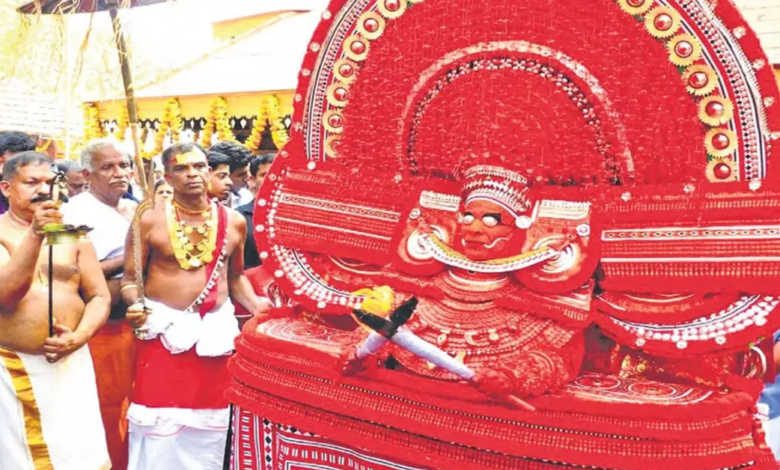
Theyyam Community Stages Protest Over Controversial Performance in UAE
KANNUR: Renowned Theyyam artist E. P. Narayanan Peruvannan has been barred from performing sacred rituals following his refusal to apologise for a controversial performance held in Ajman, UAE, last month. The performance, which included sacred Theyyams such as Kadankottu Makkavum Makkalum, Vishnumoorthy, Gulikan, and Sasthappan, has ignited a heated debate within the Theyyam community and among temple committees over alleged violations of traditional customs and rituals.
On November 24, thirteen artists under the direction of Narayanan Peruvannan carried out these holy rites at an Ajman sports club. The performers were accused by many of disregarding the sanctity of the rites, which led to harsh criticism of the act. As a result, the performers have been prohibited from playing Theyyams in kavus, or sacred groves, for a year.
Chirakkal Kovilakam has received a formal letter from the State Malayan Community Development Association requesting that it remove these artists’ ceremonial status and privileges.
The association stressed the sacred oath taken by Theyyam performers to uphold the purity and authenticity of rituals. “Some individuals are disregarding these vows by performing Theyyam on public stages, streets, and even luxury hotels,” the association stated in its letter. It further urged the Kovilakam to reclaim the ceremonial rings granted to the performers, as a step to restore the sanctity of the rituals.
As a direct consequence of this controversy, the Valapattanam Muchilottukavu Bhagavathy temple, where Narayanan Peruvannan traditionally performs the Muchilottu Bhagavathy Kolam, has decided to replace him with another performer this year. The temple committee member Shaji stated, “Narayanan Peruvannan was always our first choice.” Customs must be observed, though, and this year we have chosen a different koladhari (Theyyam performer).
Despite the criticism, Narayanan Peruvannan is unflinching. “We followed all the rituals and customs before performing in Ajman,” he told TNIE. While some of his colleagues performers have expressed regret, Narayanan, who also received a Padma Shri award, has declined to issue an apology for the incident.
Koladhari Prasoon, speaking at a press conference in Kannur, admitted, “We performed Theyyakolam under the impression that it was suitable for houses and fields during festivals. We now realise that our actions caused distress to believers. We deeply regret this and assure the community it won’t happen again.”
The controversy has also sparked criticism of the commercialisation of Theyyam. Venu Ayyankavu, district president of the Vishnumurthy Wayanad Kulavan Velayappadu Paripalana Sangham, condemned the use of sacred rituals for financial gain. “Sacred kolams meant for ancestral shrines and kavus were performed abroad, leaving devotees feeling betrayed,” he said. “It is shameful that government-honoured artists are at the forefront of this issue.”
On the other hand, some Theyyam enthusiasts have voiced concerns over the ban. They argue that the performances in Ajman were not entirely outside the traditional context. “The artists clarified that these kolams are typically performed in fields, which are public spaces. However, such decisions are now being driven by WhatsApp groups and social media platforms,” said Prabhakaran Kovoor, a Theyyam enthusiast. “It is unfortunate that the only Padma Shri recipient from the community has been banned over this matter.”
The debate highlights the growing tension between the preservation of sacred traditions and their adaptation to modern contexts, with the Theyyam community divided over how to balance ritual purity and cultural outreach.