CEPA and IMEC: Securing the Future of India-UAE Economic Relations
How CEPA and IMEC are Enhancing Trade and Connectivity Between India and the UAE

CEPA and IMEC: Strengthening India-UAE Economic Ties and Trade Connectivity
On June 23, 2024, Indian Foreign Minister Dr. S. Jaishankar made a significant visit to the United Arab Emirates (UAE), where he engaged in extensive talks with his Emirati counterpart, Sheikh Abdullah bin Zayed Al Nahyan. This visit, occurring within two weeks of Dr. Jaishankar’s reappointment as India’s External Affairs Minister, underscores the crucial role the UAE plays in India’s foreign policy strategy. Over the past four years, India and the UAE have achieved several key milestones in their bilateral relationship. These include the initiation of the India-Middle East-Europe Corridor (IMEC) cooperation, the signing of the Comprehensive Economic Partnership Agreement (CEPA) in 2022, the facilitation of trade settlements in bilateral currencies, and the integration of UAE debit and credit cards into India’s Rupay payment system.
These achievements are built upon a deep historical trade relationship between India and the UAE, which dates back centuries. As a result of this robust economic partnership, India has become the UAE’s second-largest trade partner, following China, while the UAE ranks as India’s third-largest trade partner, behind China and the United States (US).
To ensure sustained cooperation amidst global and regional geopolitical uncertainties and to support continued economic growth, both nations have intensified their collaboration on developing the IMEC corridor. This initiative is designed to complement the CEPA, which was negotiated in a record time of 88 days. The IMEC and CEPA are strategic efforts to future-proof the economies of both countries by enhancing interregional connectivity and leveraging their complementary economic strengths.
CEPA: Cementing a Promising Economic Partnership
Despite the International Monetary Fund (IMF) forecasting a 5 percent decline in global trade for 2023, the bilateral trade between India and the UAE grew by approximately 4 percent. This growth contributed 9 percent to the UAE’s international trade and 8.15 percent to India’s total trade. Since the implementation of CEPA on May 1, 2022, trade between India and the UAE has expanded by 16.4 percent, reaching USD 83.64 billion in 2024, compared to USD 72.9 billion in 2022. The CEPA agreement eliminates tariffs on approximately 19,600 commodities, classified into three groups—immediate tariff elimination, phased tariff elimination, and tariff reduction. This tariff elimination applies to 11,908 Indian tariff lines and 7,581 Emirati tariff lines. The agreement spans 18 commodity sectors and 11 service sectors, encompassing over 300 sub-sectors collectively, and benefits Indian commodities worth USD 26 billion, which previously faced a 5 percent import duty in the UAE.
The diversification of the bilateral trade basket is a notable outcome of CEPA. Historically driven by energy trade, the current trade relationship has expanded into various sectors. In the fiscal year 2024, key sectors such as aerospace manufacturing, metals and alloys, plastics, and gems and jewellery contributed significantly to the trade volume. Aerospace manufacturing accounted for USD 2 billion, metals and alloys USD 1.67 billion, plastics USD 0.89 billion, and gems and jewellery USD 8.04 billion. These sectors experienced growth rates of 24 percent, 68 percent, 57 percent, and 40 percent, respectively, between fiscal years 2021 and 2023. As a result of this diversification, India’s non-oil trade exceeded USD 50 billion in fiscal year 2024.
India-UAE Bilateral Trade Data 2020-2024 (in USD billions)
| Year | India’s Exports | UAE’s Exports | Total Bilateral Trade Volume | Total Bilateral Trade Volume (Non-Energy) | Top Commodity Export Groups — Indian (Non-Energy) | Top Commodity Export Groups — Emirati (Non-Energy) |
|---|---|---|---|---|---|---|
| 2020-21 | 16.68 | 26.62 | 43.30 | 28.67 | Iron and steel, clothing and textiles, gems and jewellery, consumer electronics | Metals and alloys, gems and jewellery, plastics and rubber goods |
| 2021-22 | 28.04 | 44.83 | 72.87 | 46.36 | Iron and steel, clothing and textiles, gems and jewellery, consumer electronics | Metals and alloys, gems and jewellery, plastics and rubber goods |
| 2022-23 | 31.61 | 53.23 | 84.84 | 48.46 | Aerospace manufactured goods, construction materials, gems and jewellery, plastics | Metals and alloys, gems and jewellery, plastics and rubber goods |
| 2023-24 | 35.62 | 48.02 | 83.64 | 57.81 | Aerospace manufacturing, construction materials, gems and jewellery, plastics | Metals and alloys, gems and jewellery, plastics and rubber goods |
Source: EXIM Data Bank, Ministry of Commerce, Government of India
Beyond commodity trade, the CEPA aims to facilitate USD 15 billion in services trade by 2027. The agreement covers 211 service sectors, including business, information technology (IT), construction, health, education, tourism, sports, and transport. The CEPA allows UAE firms to compete with Indian firms on an equal regulatory footing for government contracts and public sector works. Additionally, it permits Indian businesses to establish a 100 percent equity presence in the UAE without the need for a local partner. Both nations have committed to providing commercially meaningful market access by simplifying tax rates, land acquisition policies, and visa requirements for business purposes.
Can IMEC Act as a Trade Catalyst?
In addition to services and commodity trade, CEPA includes provisions for digital trade. The digital trade chapter aims to foster high-level cooperation between India and the UAE to address connectivity and regulatory issues, advancing both bilateral and global digital trade ambitions. A key initiative in this regard is the IMEC corridor.
IMEC was announced in September 2023 during the G20 New Delhi Summit, involving partners such as India, the UAE, the US, the European Union (EU), Saudi Arabia, Italy, France, and Germany. The corridor features an eastern maritime leg and a northern railway corridor, enhancing connectivity through interconnected energy grids, green hydrogen pipelines, and telecommunications infrastructure. The digital connectivity promoted by IMEC is vital for the long-term economic and security interests of both India and the UAE. IMEC partners will collaborate on establishing high-capacity subsea and terrestrial network cables and enabling 5G connectivity along the corridor to bridge the cross-border telecommunications divide. These developments will advance digital trade among the partner economies, foster integration, and improve interoperability among their digital payment systems.
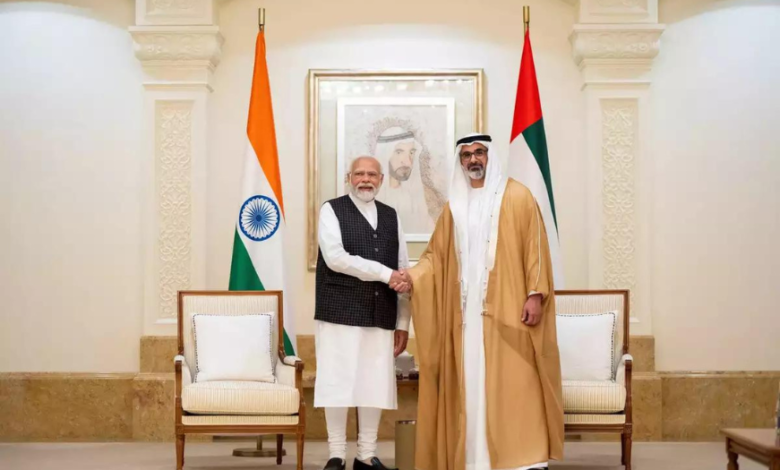
IMEC has the potential to synergize physical infrastructure with regulatory changes and trade agreements. For the India-UAE relationship, CEPA covers the regulatory and trade aspects, while IMEC addresses the physical infrastructure and connectivity. To advance corridor cooperation, an Indian high-level delegation visited three critical UAE ports—Khalifa Port, Fujairah Port, and Jebel Ali Port—in May 2024, discussing investments, port development, logistics, and supply chains. Earlier, in February 2024, Prime Minister Narendra Modi and President Sheikh Mohamed bin Zayed Al Nahyan signed 10 Memoranda of Understanding (MoUs) covering areas such as energy grids, energy storage, digital infrastructure projects, digital payments, a bilateral investment treaty, port and maritime infrastructure development, and an “Intergovernmental Framework concerning cooperation on IMEC.” These MoUs further align IMEC and CEPA.
A remarkable example of the synergy between CEPA and IMEC is the Jebel Ali Port and Free Zone (JAFZA). Strategically located in the IMEC’s eastern maritime leg, JAFZA’s trade with India has benefited significantly from CEPA. Indian and India-bound cargo traffic at JAFZA increased from 400,000 TEUs to 576,800 TEUs, with a notable increase recorded post-2022. JAFZA will also host BharatMart, a one-stop destination for showcasing Indian exports globally, scheduled to open in 2025.
Over the past two years, CEPA has played a transformative role in enhancing the India-UAE alliance by removing tariffs on a broad range of goods and services and diversifying trade. This expanding bilateral cooperation is supported by strong political trust between the highest offices of both governments. As Prime Minister Modi continues to lead the NDA government with a historic mandate, India-UAE bilateral cooperation is poised to strengthen further, enhancing trade and regional connectivity. The NDA’s continuity will also support the development of the IMEC corridor. IMEC, with its focus on infrastructure, digital connectivity, and regulatory frameworks, is set to create a seamless trade route between India, the Middle East, and Europe. This will benefit India-UAE trade under CEPA and bolster their positions as global trade and logistics hubs. The combined efforts of CEPA and IMEC are expected to drive increased trade volumes, expanded market access, and economic growth for both countries.