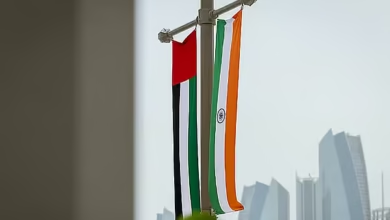
Egypt, UAE agree on $35bn deal for Mediterranean area purchase
Abu Dhabi to pay Cairo for Ras el-Hekma in two months, targeting Egypt's economic relief


Egypt has officially entered into a monumental $35 billion deal with the United Arab Emirates (UAE) to facilitate the development of the Ras el-Hekma region on its northwestern coast, as declared by Egyptian Prime Minister Mostafa Madbouly. This significant agreement comes after weeks of speculation and is poised to reshape the country’s economic landscape.
Madbouly, during a news conference attended by officials from both Egypt and the UAE, outlined the deal’s financial structure. Egypt is set to receive an initial advance of $15 billion within the upcoming week, followed by an additional $20 billion over the subsequent two months. The prime minister highlighted the unprecedented scale of this transaction, labeling it as the most substantial foreign direct investment in Egypt’s modern history.
The collaboration is framed as a partnership between the Egyptian government and a prominent Emirati consortium, spearheaded by ADQ. However, the announcement has not been without controversy, as critics of the government voiced their objections, contending that the coastal land in question, considered among Egypt’s most valuable, should have been developed by local investors.
Madbouly addressed these concerns by clarifying that, despite the private nature of the investment with the UAE consortium holding the majority of shares, the Egyptian state will retain a significant 35 percent share of the project’s profits.
The expansive scope of the Ras el-Hekma project encompasses a staggering 170 million square meters. It is designed to feature residential neighborhoods, tourist resorts, educational institutions such as schools and universities, an industrial zone, a central financial and business district, an international marina catering to tourist yachts, and an international airport located south of the city.
As part of the deal, the UAE has already deposited $11 billion in the Central Bank, earmarked to be converted into a grant. Madbouly asserted that this financial injection is expected to alleviate the ongoing economic crisis in Egypt. Addressing concerns about the current inhabitants of the Ras el-Hekma area, the prime minister assured that they will be relocated to alternative areas and offered financial compensation to mitigate fears of forced evictions.
The announcement had an immediate impact on financial markets, with the parallel market price of the US dollar dropping by 5 Egyptian pounds, settling at 57 compared to the previous day’s 62, as reported by the state-linked Cairo24 website.
Against the backdrop of Egypt’s severe economic challenges, including record inflation and foreign currency shortages, the country is actively engaged in negotiations with the International Monetary Fund (IMF) for a bailout deal exceeding $10 billion. Madbouly conveyed optimism on this front, stating that Cairo is now “very, very few steps away” from finalizing a deal with the IMF, particularly following the substantial investments in Ras el-Hekma.
Khaled Ikram, an economist and former director of the World Bank Egypt department, emphasized that the deal’s announcement should fortify Egypt’s position in negotiations with the IMF. He anticipates that it will assuage concerns of potential default on external obligations and provide reassurance to creditors and investors regarding sustained support for Egypt’s economy, particularly from Gulf countries.
Egypt, home to a population exceeding 109 million, has been grappling with a severe economic crisis, exacerbated by soaring inflation and foreign currency shortages. Annual inflation reached nearly 40 percent in August, pushing many Egyptians to or below the poverty line. The economic turmoil has been further compounded by a quadrupling of foreign debt to $164 billion during President Abdel Fattah el-Sisi’s nearly 10-year tenure, with debt servicing absorbing a substantial portion of the state’s annual expenditures.
Against this backdrop, Egypt’s foreign currency reserves stand at $35 billion. However, the ratio of short-term debts to foreign currency reserves in 2022 has surged to 80 percent, double the figure recorded in 2021, underscoring the acute economic challenges facing the nation.