


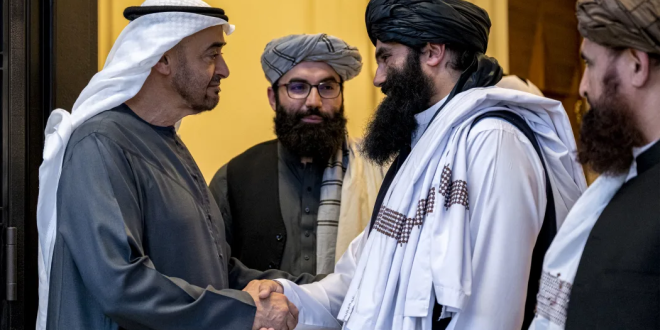
UAE President Hosts Taliban Official Wanted by US in Abu Dhabi Meeting
The meeting between the President of the United Arab Emirates (UAE), Sheikh Mohammed bin Zayed Al Nahyan, and Sirajuddin Haqqani, a prominent Taliban official, at the Qasr Al Shati palace in Abu Dhabi has sparked considerable international interest. Haqqani, who is wanted by the United States with a $10 million bounty on his head, holds significant positions within the Taliban, serving as its interior minister and leading the notorious Haqqani network. Despite his wanted status and allegations of orchestrating deadly attacks in Afghanistan, Haqqani was warmly received by the UAE leadership, signaling a departure from the approach taken by many Western nations, which typically avoid direct engagement with the Taliban.
Reported by the state-run WAM news agency, the meeting aimed to explore avenues for enhancing bilateral cooperation between the UAE and the Taliban, with a particular focus on economic development and regional stability. Details of the discussions remain scarce, but both parties emphasized the importance of mutual interests and cooperation in their official statements. Abdul Haq Wasiq, the Taliban’s intelligence chief who was previously detained at Guantanamo Bay and later released in a prisoner exchange, was also present at the meeting, highlighting its significance.
This diplomatic engagement underscores the differing approaches taken by various nations towards engaging with the Taliban. While countries like China and Qatar have sought dialogue with the Taliban leadership, Western powers, notably the United States, have remained cautious, wary of legitimizing a group with a history of violence and human rights abuses.
The United States has refrained from commenting on the UAE-Taliban meeting, which occurred in close proximity to the US Embassy in Abu Dhabi. The UAE’s decision to engage with Haqqani and the Taliban reflects its nuanced approach to regional dynamics, balancing its security ties with the US with its strategic interests in the broader Middle East.
Furthermore, this diplomatic encounter takes place against the backdrop of ongoing efforts by the international community to provide humanitarian aid to Afghanistan, which continues to face severe economic and social challenges in the aftermath of decades of conflict and instability. As the situation in Afghanistan evolves and the Taliban navigates its relations with the global community, such diplomatic engagements will likely continue to shape the country’s trajectory and its interactions on the world stage.