


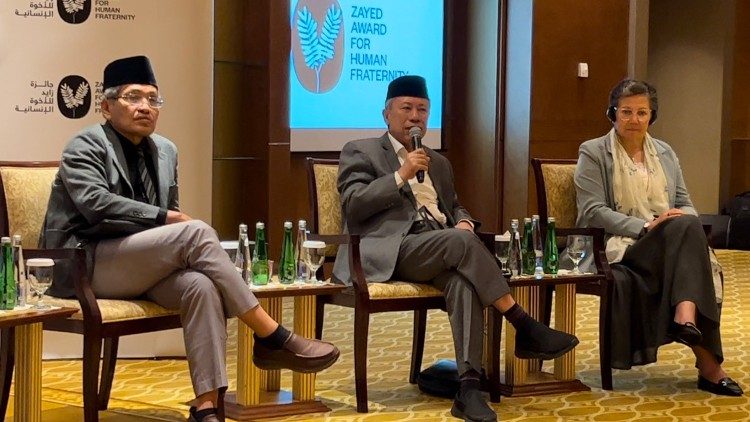
Nahdlatul Ulama, recognized as the largest Islamic organization globally with over 121 million members, has played a pivotal role in upholding Indonesia’s founding principles of Pancasila. The organization, honored with the Zayed Award for Human Fraternity for its humanitarian efforts, has successfully addressed challenges posed by religious extremism and radicalism in the world’s most populous Muslim-majority country.

Countering Extremism Through Tolerance
Ulil Abshar-Abdalla, an eminent scholar from Nahdlatul Ulama, highlighted the organization’s commitment to countering the idea of an Islamic state, a challenge faced by many Muslim-majority nations globally. Notably, Nahdlatul Ulama has navigated this challenge through a model of peaceful coexistence and religious tolerance, promoting the core values of Pancasila.
Embracing Diversity and Multi-culturalism
Abshar-Abdalla emphasized Indonesia’s multi-religious, multi-ethnic, and multi-cultural identity as essential for fostering a solid common ground among its diverse population. Defending the legitimacy of the nation-state of Indonesia, based on the five principles of Pancasila, has been crucial in overcoming movements advocating for an Islamic state.
Education as a Counter-Radicalization Tool
Despite facing threats post the September 11 attacks, Indonesia successfully focused on education to counter radicalization. Prioritizing values of peace, harmony, and tolerance, Indonesia developed an education system based on moderation, encouraging respect for diversity and other faiths.
Promoting Dialogue and Understanding
Nahdlatul Ulama operates thousands of madrasas and educational institutions across Indonesia, providing affordable yet quality education. The organization has been instrumental in fostering interfaith dialogues and forums, bringing together religious leaders to address common issues and promote understanding.
Harmonizing Islam, Democracy, and Development
Indonesia’s unique success story lies in the harmonious integration of Islam, democracy, and economic development. Abshar-Abdalla pointed out that Indonesia has demonstrated the compatibility of seemingly contradictory elements, debunking misconceptions about the coexistence of Islam and democracy.
UAE-Indonesia Educational Collaboration
The ongoing collaboration between the UAE and Indonesia in the field of education, exemplified by the Mohammed bin Zayed College of Future Studies in Yogyakarta, reflects a shared commitment to promoting knowledge and understanding. This initiative, witnessed by President Joko Widodo and Minister Suhail Al Mazrouei, exemplifies the vision of Sheikh Mohammed bin Zayed Al Nahyan in fostering educational cooperation.
Zayed Award for Human Fraternity: A Platform for Awareness
Abshar-Abdalla sees the Zayed Award for Human Fraternity as a platform to raise awareness of Indonesia’s model of peaceful coexistence, emphasizing the nation’s success in integrating Islam, democracy, and economic development. This recognition serves as a testament to Nahdlatul Ulama’s impactful contributions through education, social projects, and initiatives.