


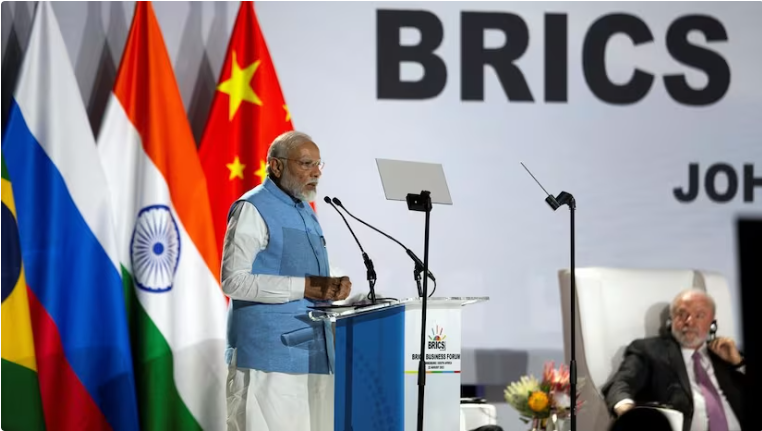
In a significant move, the BRICS bloc, consisting of major emerging economies like India, Russia, and China, has welcomed five new full members—Egypt, Ethiopia, Iran, Saudi Arabia, and the United Arab Emirates. Russian President Vladimir Putin, marking Moscow’s presidency of BRICS, announced the expansion, bringing the total number of member nations to 10. This expansion is a strategic step to enhance BRICS’ global influence, countering the backdrop of Western dominance in international affairs.
The decision to admit these new members was taken during the BRICS summit in Johannesburg last August, where six countries, including Argentina, were approved for entry into the bloc, effective from January 1. However, Argentina’s recent withdrawal under President Javier Milei shifted the dynamics.
Putin underscored the significance of Egypt, Ethiopia, Iran, Saudi Arabia, and the UAE joining as full members, noting the growing authority of BRICS in global affairs. Established in 2006 as BRIC and expanded to BRICS with South Africa’s inclusion in 2010, the group is attracting nations that share its principles of sovereign equality, openness, consensus, and the pursuit of a multipolar international order.
With original members Brazil, Russia, India, China, and South Africa, BRICS collectively represents a substantial portion of the global economy. Putin outlined Russia’s agenda for its 2024 BRICS chairmanship, emphasizing positive cooperation, integration of new participants, and potential inclusion of around 30 other interested countries in BRICS’ multi-dimensional agenda.
During the Russian presidency, priorities include strengthening foreign policy coordination, addressing global security challenges, and fostering collaboration in science, technology, healthcare, environmental protection, culture, and sports. Putin announced a series of over 200 events across Russian cities during the chairmanship, culminating in the BRICS Summit in Kazan in October—a testament to the bloc’s commitment to shaping a new era of collaborative and inclusive global governance.